Open Backtest enters closed beta
A first look at the workspace we are building for market replay, simulated trading, backtest review, and developer workflows.
Today, Open Backtest is entering closed beta.
This is the first version we are ready to put in front of a small group of traders, strategy builders, and developers. It brings the core workflow into one place: organize an idea, replay the market, record simulated trades, inspect the result, and continue the same work through an API.
Why we are building Open Backtest
Backtesting is often split between disconnected tools. A chart contains the visual reasoning, a spreadsheet contains the trades, a script contains another version of the strategy, and the useful context disappears between sessions.
Open Backtest is designed around a simpler principle: the chart, the execution history, the statistics, and the programmable interface should describe the same backtest.
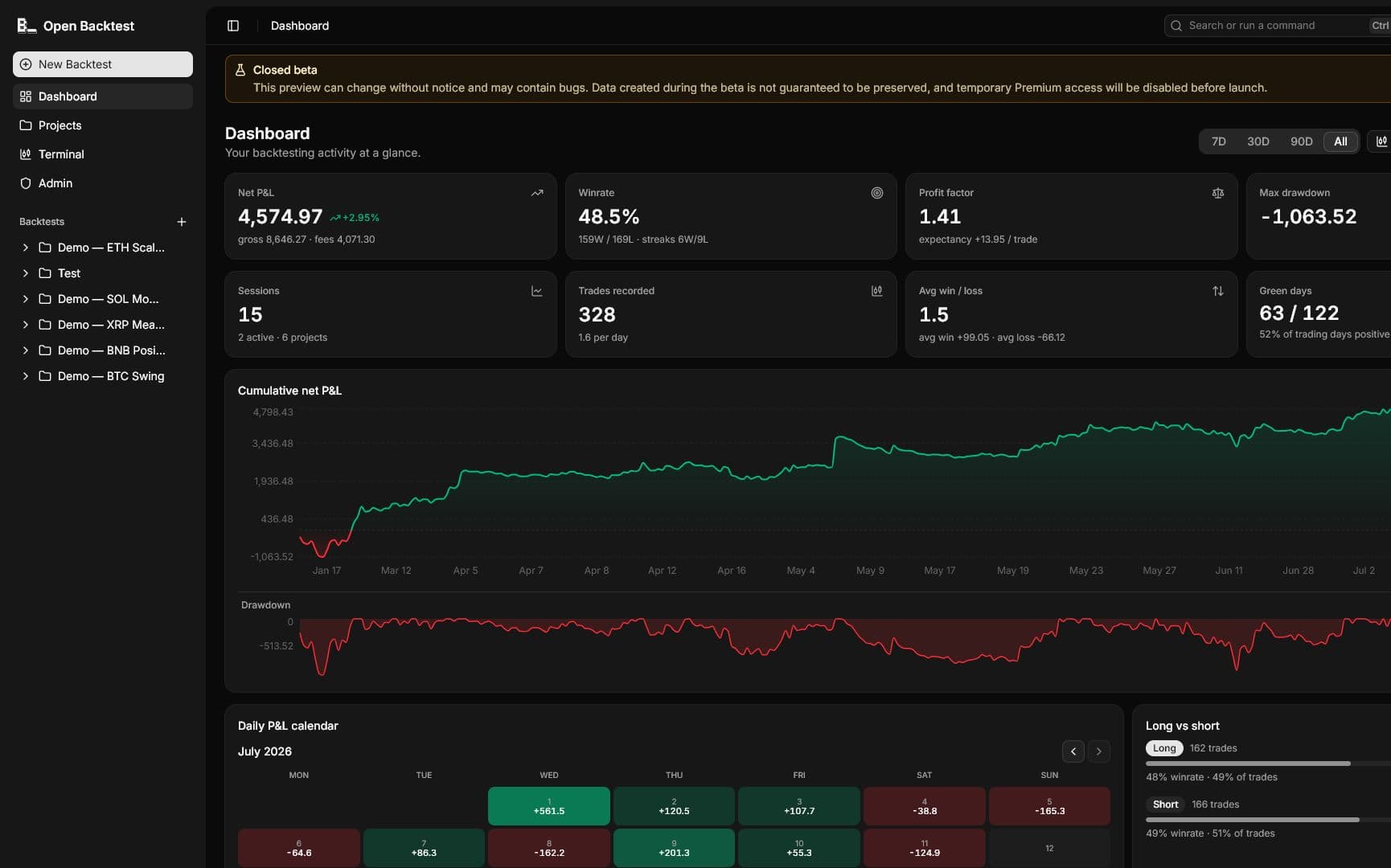
The dashboard turns completed sessions into a practical review surface. Net P&L, drawdown, expectancy, trade distribution, long-versus-short behavior, and activity over time are derived from the trades already attached to each session.
From an idea to a replayable workspace
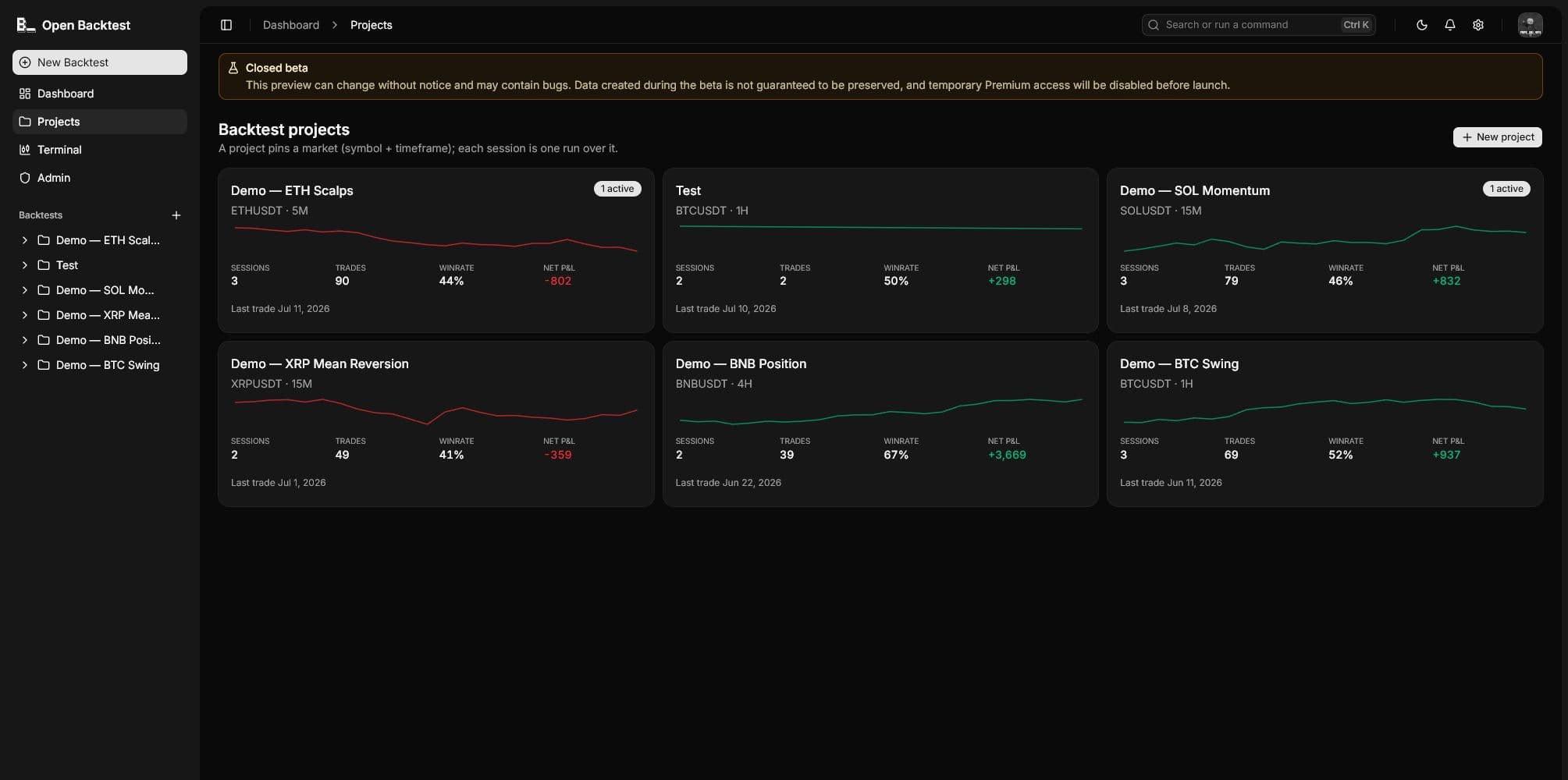
Every backtest belongs to a project. A project keeps the market, timeframe, sessions, starting balance, fees, and review history together instead of leaving isolated charts behind.
Sessions can be resumed, compared, archived, or removed. The goal is not only to produce a final number, but to preserve enough context to understand how that number was produced.
Replay first, then automate
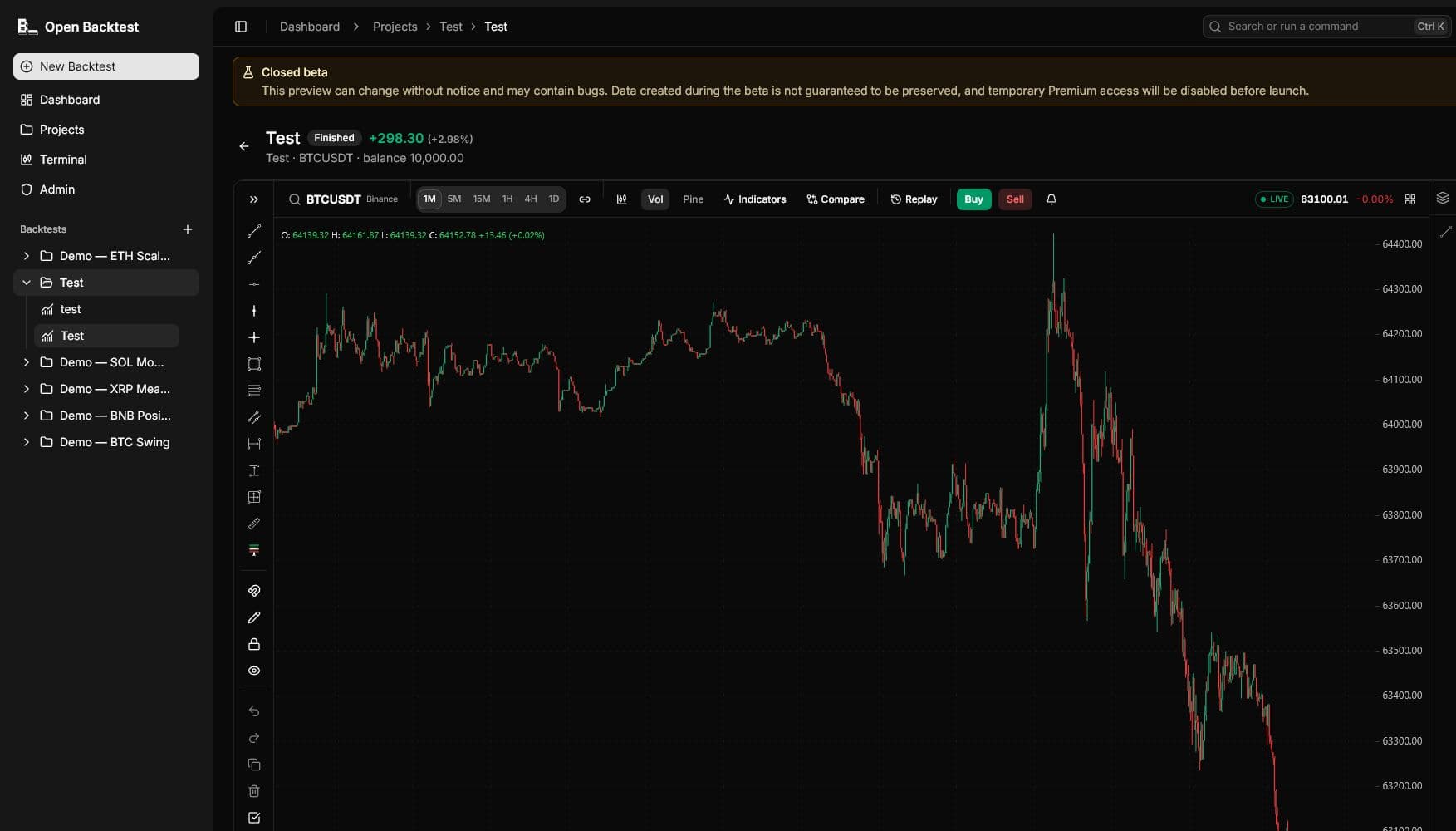
The terminal is the center of the manual workflow. It combines historical candles, chart tools, simulated long and short positions, fees, trade history, and session persistence. Saved chart state is intended to restore the analysis, drawings, and trades when a session is reopened.
The same model is exposed to developers. API keys, the REST API, and the Python SDK are designed so a scripted backtest can create projects and sessions, submit trades, and appear alongside manual work in the application.
What is included in the beta
- Project and session management for repeatable backtests.
- Historical market replay with simulated long and short trades.
- Persistent chart sessions, drawings, trades, balances, and fee settings.
- Performance analytics across trades, sessions, projects, symbols, and time periods.
- A developer API and Python SDK for automated workflows.
- Organization workspaces, invitations, seats, and account security features.
- Bilingual product and developer documentation in English and French.
What we need to learn
The closed beta is not a claim that the product is finished. It is a controlled environment for answering concrete questions:
- Does the project/session model match the way people actually iterate on strategies?
- Which statistics help identify a fragile result instead of merely making it look good?
- Does chart restoration preserve enough context to continue an analysis later?
- Can manual and scripted sessions coexist without creating two separate products?
- Where do the terminal and onboarding create friction or ambiguity?
Feedback and error reports collected with permission will be used to prioritize those fixes. The application includes direct feedback tools, and diagnostic collection remains optional.
What comes next
Work during the beta will focus on the charting and replay library, restoration reliability, financial-data delivery through the protected API, onboarding, documentation, and a clearer public landing experience.
Open Backtest does not provide investment advice, and simulated or historical results do not predict future performance. The purpose of the platform is to make the testing process more observable, repeatable, and honest.
Join the closed beta